Common Pilates Form Mistakes and How to Fix Them
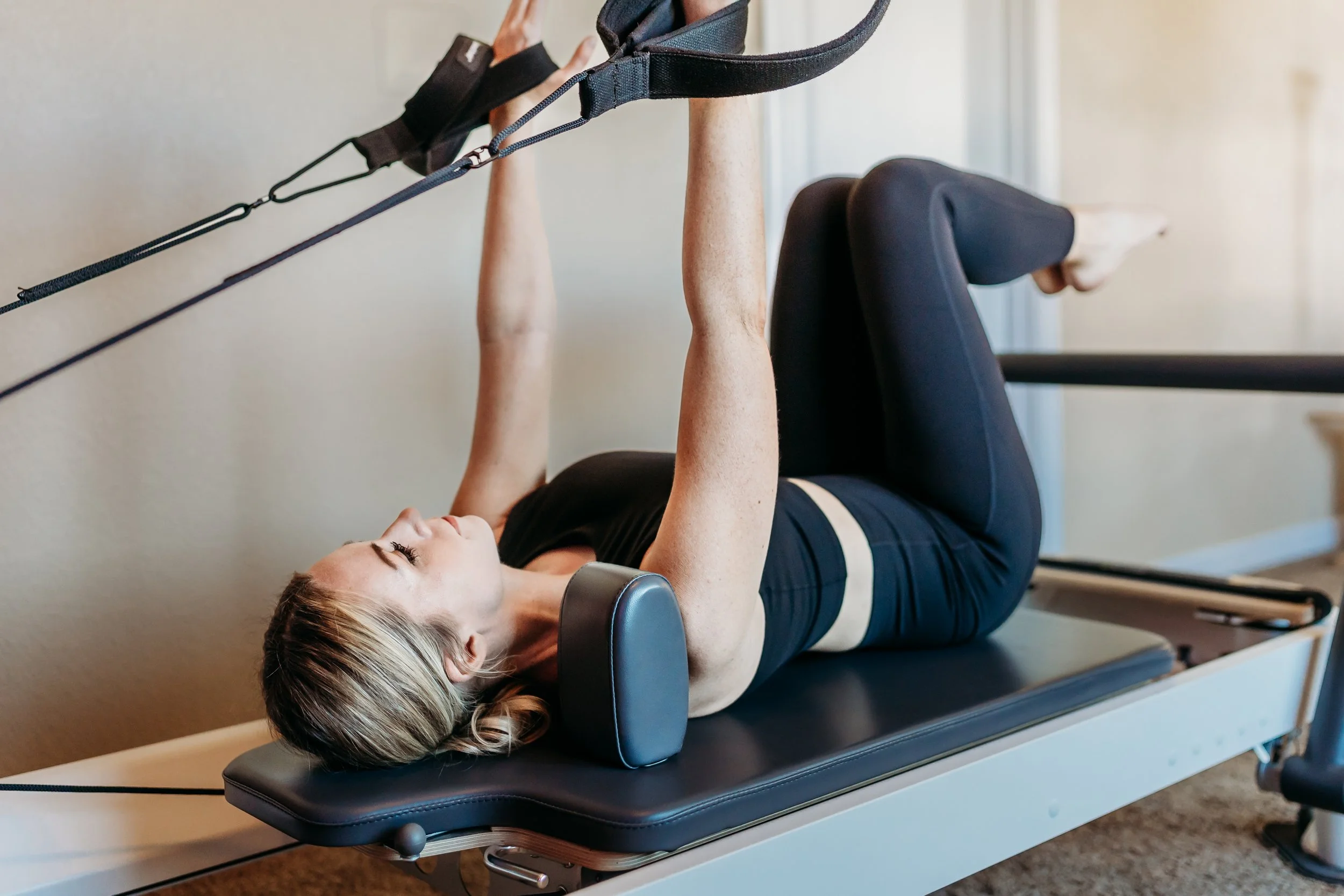
One of the things I love about Pilates is that the smallest adjustments can completely change an exercise. Move your ribs a little. Relax your shoulders. Slow down. Stop gripping your hip flexors. Suddenly, an exercise you’ve done a hundred times feels completely different and usually a lot harder. That’s because Pilates isn’t really about how many repetitions you can do; it’s about how you do them.
And before anyone starts worrying about whether they’ve been doing Pilates “wrong,” let me say this: form is something we’re constantly working on. Even experienced Pilates students need reminders and corrections. I still think about my own alignment when I practice. That awareness is part of Pilates.
Here are some of the most common form issues I see and a few simple ways to fix them.
Mistake #1: Holding Your Breath
This might be the most common one. You’re concentrating so hard on what your arms, legs, core, and pelvis are supposed to be doing that suddenly you realize...you haven’t taken a breath. Breathing is an important part of Pilates because it helps coordinate movement, engage the core, and release unnecessary tension.
The fix: If the breathing pattern feels like one more thing to think about, don’t overcomplicate it. Just breathe. Once the movement feels more familiar, you can start coordinating your breath with the exercise. I would much rather have you breathing “at the wrong time” than not breathing at all.
Mistake #2: Letting Your Ribs Pop
If you’ve taken one of my classes, there’s a pretty good chance you’ve heard me talk about your ribs. When the arms travel overhead or an exercise becomes challenging, the rib cage sometimes wants to lift away from the body. When that happens, we often compensate by arching through the lower back instead of maintaining core support.
The fix: Think about keeping the front of your ribs connected toward your pelvis without smashing your back into the mat. You should still be able to breathe and move. It’s a subtle adjustment, but it can completely change what you feel.
Mistake #3: Living in Your Shoulders
We carry so much tension in our shoulders, and Pilates has a funny way of exposing it. During planks, arm work, abdominal exercises, or even Footwork, the shoulders can start creeping toward the ears.
The fix: Think about creating space between your ears and shoulders. Let your shoulder blades settle onto your back instead of forcing them downward. Sometimes I'll simply cue, “Get your shoulders out of your ears.” It usually works.
Mistake #4: Using Momentum Instead of Control
If you have to swing your body to complete an exercise, there’s a good chance momentum is doing some of the work your muscles should be doing. Rolling exercises are a perfect example. Roll Up, Teaser, and even Rolling Like a Ball can quickly turn into a game of throwing yourself forward and hoping for the best. We've all been there.
The fix: Slow down. Try making the movement smaller or modifying the exercise until you can control it. Pilates becomes much more challenging when you remove momentum—which is exactly the point.
Mistake #5: Gripping the Hip Flexors
Have you ever been doing abdominal work and thought, Why do I feel this entirely in the front of my hips? Your hip flexors are supposed to work during many Pilates exercises, so feeling them isn't automatically a problem. But sometimes they start taking over when the abdominal muscles aren't providing enough support or when the exercise is currently too demanding.
The fix: Change the position of your legs, decrease the range of motion, or put your feet down. There is absolutely no prize for keeping your legs lower if your form falls apart.
Mistake #6: Tucking the Pelvis All the Time
Pilates involves different pelvic positions depending on the exercise, but sometimes people learn to “engage their core” by permanently tucking their pelvis underneath them. Your pelvis is meant to move.
The fix: Learn what neutral feels like and recognize when an exercise calls for neutral versus an imprint or posterior tilt. This is one of those things that becomes easier with practice. The more body awareness you develop, the easier it becomes to recognize where your pelvis is without constantly looking at it or thinking about it.
Mistake #7: Locking Your Joints
Straight doesn't necessarily mean locked. I often see people hyperextend their knees or elbows because they’re trying so hard to make the limb completely straight.
The fix: Think about length instead of locking. Reach through your arms and legs while keeping muscular support around the joints. You can have a beautifully long line without hanging into your knees or elbows.
Mistake #8: Going for a Bigger Range of Motion Than You Can Control
More is not always better. A higher leg, deeper stretch, bigger circle, or lower Teaser position doesn't automatically make an exercise more effective. Sometimes making an exercise smaller actually makes it much harder because you’re finally working in a range you can control.
The fix: Choose the range where you can maintain your alignment. As your strength and mobility improve, your range may naturally increase. There's no reason to force it.
Mistake #9: Rushing Through the Exercise
Pilates is not a race. If you're moving quickly just to get through the repetitions, you're probably missing a lot of what makes the exercise valuable.
The fix: Give yourself permission to slow down. Feel where the movement starts. Notice what stays stable. Pay attention to what happens when you return to your starting position—not just when you move away from it. The return is often where the real work happens.
Mistake #10: Thinking a Modification Means You're Doing Less
This might be the form mistake I care most about correcting—and technically, it isn't even physical. People sometimes choose an advanced variation even when they can't maintain their form because modifying feels like taking a step backward.
It isn't.
The fix: Choose the version that allows you to perform the exercise well. A modification isn't a failure. It's a tool. Sometimes the smartest and most advanced thing you can do is recognize what your body needs and adjust accordingly.
Good Form Isn't About Looking Perfect
Pilates form isn't about making every person look exactly the same. Bodies are built differently. We have different proportions, mobility, strength, injuries, and movement histories. An exercise may look slightly different from one person to another and still be completely appropriate for both. Good form is really about intention.
Are you controlling the movement? Are you breathing? Are the right muscles doing the majority of the work? Can you maintain your alignment without unnecessary tension? Those questions matter much more to me than whether your exercise looks picture-perfect.
A Final Thought
Pilates is called a practice for a reason. You don't master your form and suddenly never need another correction. As you get stronger and more experienced, you actually tend to notice more. You feel the rib that wants to pop. You notice when one hip starts doing something different than the other. You catch your shoulders creeping toward your ears before I even have the chance to say anything. That awareness is progress.
So the next time an instructor corrects your form, don't think of it as something you were doing wrong. Think of it as an opportunity to get a little more out of the movement. Sometimes one tiny adjustment is all it takes to make you say the words every Pilates instructor secretly loves to hear: “Ohhh...NOW I feel it.”
-Natalie
