The Best Pilates Mat and Reformer Exercises for a Strong Back
When people talk about Pilates, the core usually gets all the attention, but your core is a lot more than your abs. Your back muscles are a huge part of the equation, and having a strong back is important for everything from good posture to lifting groceries, sitting at a desk, playing sports, and simply moving through everyday life without feeling like your body is fighting you.
I also think we spend so much time moving forward—sitting, driving, looking at phones, working on computers, that our backs deserve a little extra attention. One of the things I love about Pilates is that it doesn't just strengthen the back in isolation. We work the back along with the abdominals, glutes, shoulders, and hips so the entire body learns to support the spine.
Here are some of my favorite mat and Reformer exercises for building a strong, supported back.
First, What Do We Mean by a “Strong Back”?
A strong back isn't necessarily about having huge back muscles. We're talking about having enough strength and endurance throughout the muscles surrounding your spine, shoulders, and pelvis to support you as you move. Your abdominals matter too.
I sometimes think people hear “back strengthening” and assume we need to do endless back extensions. But your spine is supported from all directions. Your abdominal muscles, glutes, hips, and back muscles all need to work together. That's one reason Pilates is so effective. We're rarely training just one muscle at a time.
MAT: Swimming
Swimming is probably one of the first exercises that comes to mind when I think about back strengthening on the mat.
Lying on your stomach, you extend your opposite arm and leg and then alternate sides in a swimming motion.
It works the muscles along the back of the body while also challenging coordination and core stability. And you don't have to make it huge. In fact, I would much rather see a smaller lift with length through the spine than someone trying to get their arms and legs as high as possible and crunching into their lower back. Think long, not high.
MAT: Swan
I love Swan because it gives us something many of us don't get enough of during the day: spinal extension.
We're constantly bending forward. Swan asks us to go the other direction.
Depending on the variation, you can start with a very small extension and gradually progress to a larger movement. The goal is to distribute the extension throughout the spine rather than dumping everything into the lower back. When done well, Swan strengthens the back while opening the front of the body. And after spending hours sitting at a computer or looking down at a phone, that can feel really good.
MAT: Single Leg Kick
Single Leg Kick is another great exercise for the entire back body.
You're propped on your forearms while alternating bending each knee, which means your upper back, shoulders, abdominals, glutes, and hamstrings all have jobs to do.
I especially like this one because maintaining the lifted position requires endurance. You're not just moving your legs. You're holding your entire trunk in an organized position while the legs move underneath you.
MAT: Double Leg Kick
Double Leg Kick takes things a little further.
This exercise combines back extension, shoulder mobility, and hamstring work. I love the contrast between bending the knees and then reaching the arms and legs away as the chest lifts.
There's a lot happening in what looks like a fairly simple exercise. It's a great reminder that strengthening the back doesn't always mean doing one isolated “back exercise.” The whole posterior chain can work together.
MAT: Bridge
Bridge might not immediately come to mind as a back exercise, but I absolutely include it when I'm thinking about building a strong, supported spine.
Your glutes and hamstrings play an important role in supporting your pelvis and lower back. Bridge strengthens both while also giving us an opportunity to work on pelvic stability or spinal articulation, depending on how we perform it. I use some version of bridging constantly because it translates so well to everyday movement. Plus, there are endless ways to progress it once the foundation is strong.
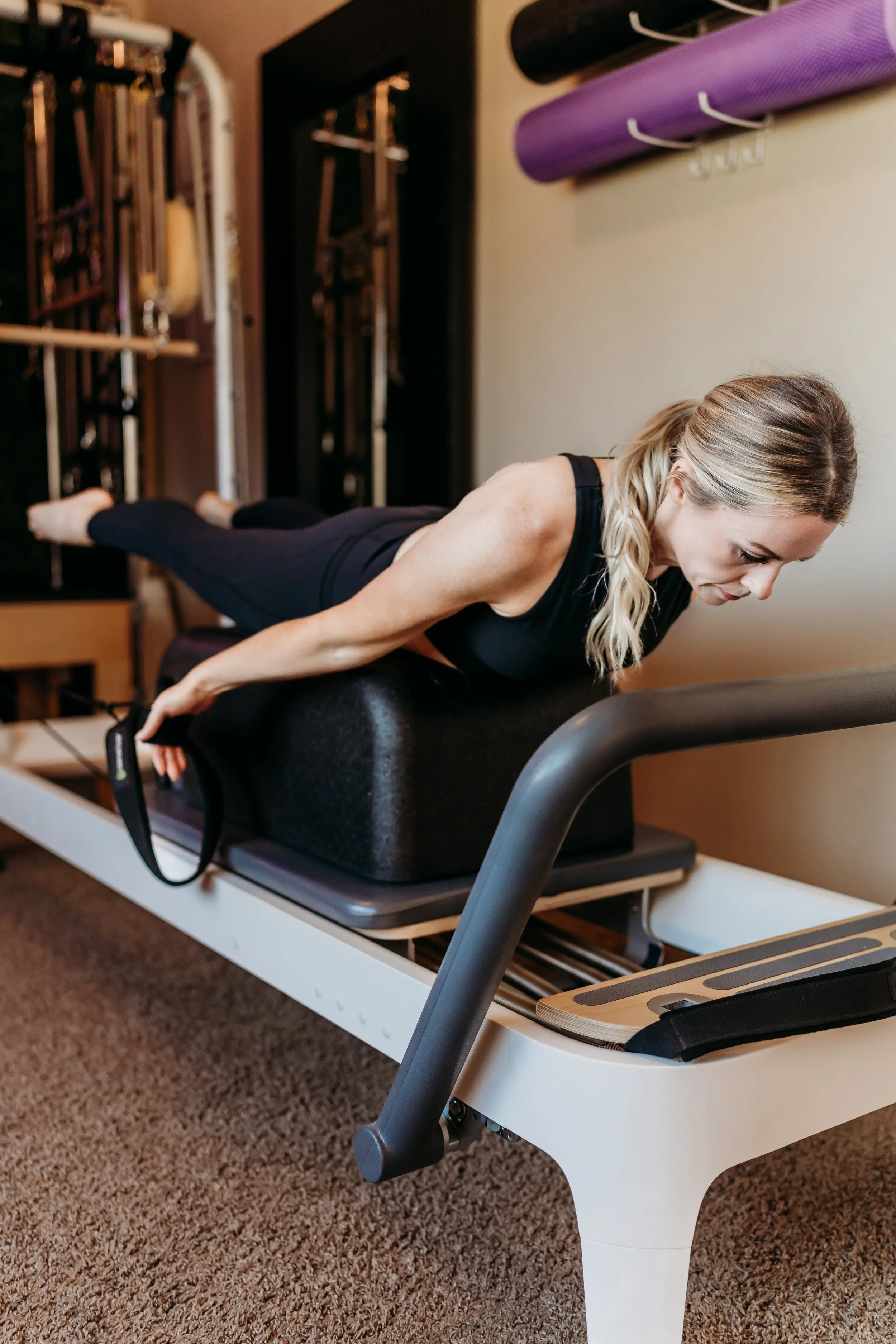
REFORMER: Pulling Straps
Pulling Straps is easily one of my favorite Reformer exercises for the upper back.
Lying prone on the long box, you pull the straps alongside the body while reaching through the crown of your head and maintaining a long spine.
It strengthens the upper back, posterior shoulders, and arms while asking the abdominals and glutes to support the trunk. This is another exercise where bigger isn't necessarily better. You don't need to crank your chest toward the ceiling. Think about reaching forward and up while the arms reach long behind you. When everything connects, it feels incredibly strong.
REFORMER: T-Pull
T-Pull is usually paired with Pulling Straps, and I love what it does for the upper back and shoulders.
With the arms starting out to the sides, you pull them toward the body against the resistance of the straps.
It can be surprisingly challenging. This is especially helpful for strengthening some of the muscles that support good posture—which is something most of us could use more of considering how much time we spend sitting and looking forward.
REFORMER: Swan on the Long Box
Swan on the Reformer takes the extension work we do on the mat and adds the feedback and movement of the carriage.
There are different versions depending on experience level, but the basic goal is still the same: create controlled extension through the spine while maintaining support from the abdominals and lower body.
I love the Reformer for teaching this because the springs can provide both assistance and resistance. It helps you feel where the movement is coming from.
REFORMER: Breaststroke
Breaststroke is such a beautiful exercise when it's done with control.
It combines upper-back strength, spinal extension, shoulder mobility, and coordination. Depending on the variation, the straps provide resistance as the arms reach forward and circle around.
It can also be pretty humbling. There is no hiding from the springs. You have to control the movement in both directions, which is exactly what makes it so effective.
REFORMER: Rowing
The Rowing series is another favorite for strengthening the upper back while also challenging the core.
There are several exercises within the series, and they combine arm movement, spinal articulation, shoulder stability, and postural strength.
What I love about Rowing is that it reinforces something we use constantly in Pilates: the arms don't move independently of the rest of the body. Your trunk has to support what's happening at your shoulders. That's also how our bodies are designed to move in real life.
Don't Forget the Rest of the Body
If your goal is a stronger back, don't only train your back. Strengthen your abdominals. Strengthen your glutes. Work on hip mobility. Improve your shoulder stability. Practice rotation, flexion, extension, and lateral movement when those movements are appropriate for your body. Our bodies don't operate as a collection of separate parts, and Pilates doesn't train them that way. That's one of the things I love most about it.
What If Your Back Already Hurts?
There's an important difference between strengthening a healthy back and exercising when you're experiencing back pain. Pilates can be incredibly helpful for many people, but back pain can have many different causes. An exercise that feels wonderful for one person may not be appropriate for someone else. If you're dealing with persistent, unexplained, or significant back pain, get guidance from your healthcare provider or physical therapist before trying to exercise your way through it. And once you're cleared for Pilates, work with an instructor who can modify exercises for your body. You should never feel like you have to push through pain to make an exercise count.
A Final Thought
A strong back isn't just something we want for our Pilates practice. It's something we want for life. We want to be able to stand tall, carry things, travel, work, exercise, play with our kids or grandkids, and continue doing the things we enjoy without constantly thinking about our backs. Pilates gives us so many ways to build that strength, both on the mat and on the Reformer. And the best part is that while we're strengthening the back, we're also working the core, hips, shoulders, glutes, balance, coordination, and body awareness. Because in Pilates, nothing really works alone snd neither does your back.
-Natalie
